

Promag
The Different
The Different
NDT Method
Overview
The Different NDT Method
Non-Destructive Testing (NDT) can be broadly classified into two main categories: surface defect inspection and internal defect inspection. The representative methods for each type are as follows:
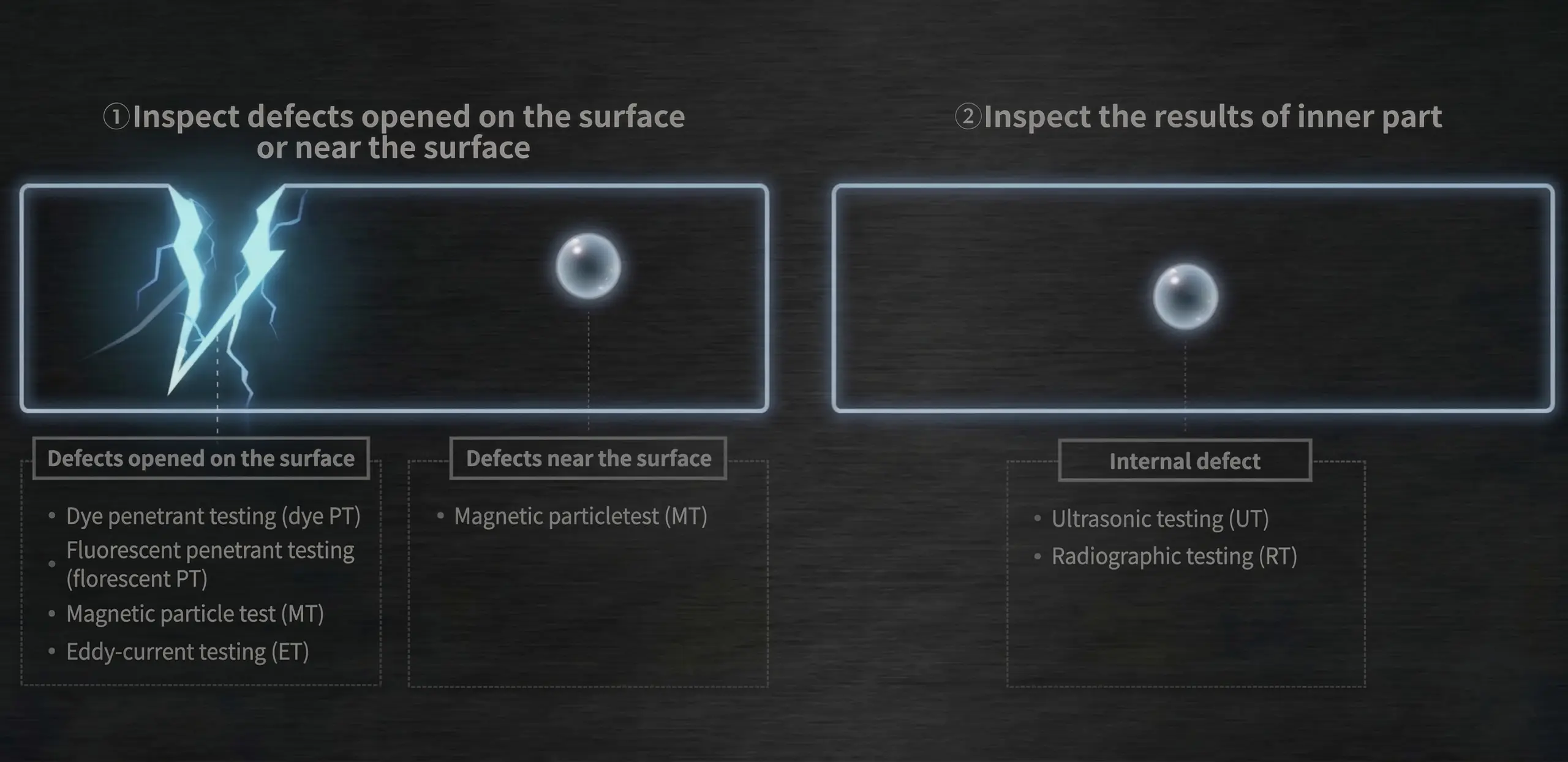 Surface vs Internal
Surface Defects
Test Methods for Surface Defects
| Test Method | Types of Defects | Materials Covered | Speed | Features | Necessary Items |
|---|---|---|---|---|---|
| PT Dye penetrant testing Learn More | Surface-opening defects | Metallic & non-metallic materials | Slow |
|
|
| PT Fluorescent Penetrant Testing Learn More | Surface-opening defects | Metallic & non-metallic materials | Medium to fast |
|
|
| MT Magnetic Particle Testing Learn More | Surface & near-surface defects | Ferromagnetic materials only | Fast |
|
|
| ET Eddy Current Testing Learn More | Defects openings on the surface | Conductive materials | Very fast |
|
|
| VT Visual Testing Learn More | Visible surface defects | All materials | Very fast |
|
|
Internal Defects
Inspection method for internal defects
| Test Method | Types of Defects | Materials Covered | Speed | Features | Necessary Items |
|---|---|---|---|---|---|
| UT Ultrasonic Testing Learn More | Subsurface / Internal defects | Metallic & non-metallic materials | Fast |
|
|
| RT Radiographic Testing Learn More | Internal defects | Metallic & non-metallic materials | Slow to medium |
|
|
Common Questions
Non-Destructive Testing FAQs
What is NDT?
Non-Destructive Testing (NDT) also known as Non-Destructive Examination (NDE) refers to any type of non-invasive inspection technology used to inspect an object without damaging it in any way.While there are several types of NDT/NDE, it is generally understood that these methods are capable of identifying the presence of damage or the mechanisms that may cause damage such as cracks, corrosion, ineffective welds, part misalignment, and so on.
How to do NDT Testing?
- Defining the Scope and PlanningBefore any testing begins, our certified specialists work with you to define the scope of the inspection. This involves identifying the material types, the specific codes or standards (such as ASME or API) that must be met, and the most effective NDT method for the task. We review previous inspection reports and technical blueprints to understand the history of the asset and target the areas most likely to experience stress or corrosion.
- Site and Surface PreparationThe accuracy of NDT relies heavily on the condition of the test surface. Our technicians begin by cleaning the area to remove dirt, grease, scale, or loose paint that could mask defects or interfere with sensors. We also establish safety protocols, particularly for methods like Radiography which require cordoned-off areas, to ensure the inspection environment is controlled and compliant with local safety regulations.
- Equipment Calibration and SetupTo ensure precision, all NDT instruments must be calibrated against known standards. Before the actual test, the technician performs "performance checks" using test blocks with artificial defects. This confirms that the equipment is functioning correctly and is sensitive enough to detect the minimum defect size required by your industry’s standards.
- Execution of the TestDuring the inspection phase, the technician meticulously applies the chosen NDT method. Whether they are sweeping an ultrasonic probe across a weld, applying magnetic particles to a steel joint, or capturing a radiographic image, the focus is on total coverage. In this stage, we are looking for "indications"—any signal or visual cue that suggests a break in the material's integrity.
- Data Interpretation and AnalysisOnce the data is collected, a certified Level 2 or Level 3 technician interprets the results. This is where expertise matters most: the inspector must distinguish between harmless "non-relevant indications" (like surface geometry) and actual "defects" (like cracks or lack of fusion). They evaluate these findings against the "Accept/Reject" criteria specified in the project's code to determine if the part is fit for service.
- Reporting and Follow-upThe final step is the delivery of a comprehensive NDT report. This document includes a map of any identified flaws, the specific equipment settings used, and the final pass/fail certification. If a defect is found, we provide the data necessary for your engineering team to plan repairs. After any necessary work is completed, we often perform a "post-repair" inspection to verify that the integrity of the asset has been fully restored.
What are The Advantages of NDT?
- Safety Assurance: NDT allows for the inspection of materials and components in a manner that does not compromise their integrity, ensuring continued safety and functionality.
- Failure Prevention: By detecting defects early, NDT helps prevent potential failures that could result in costly and hazardous outcomes.
- Cost Efficiency: Reducing the need for repairs and allowing for more controlled maintenance schedules lowers the overall costs associated with material management.
- Quality Assurance: Regular NDT ensures that components meet the quality standards required for their intended use, maintaining high levels of performance.
- Environmental Protection: With minimal waste production, NDT is more environmentally friendly compared to destructive methods.
What are the 5 most common of NDT?
- Visual Testing (VT): The simplest and most widely used NDT method. It involves the direct inspection of a material or component to identify surface defects. This method often employs tools like magnifying glasses, mirrors, and borescopes to enhance visibility.
- Ultrasonic Testing (UT): Uses high-frequency sound waves to detect internal flaws in materials. The sound waves travel through the material and reflect back from any discontinuities, providing detailed information about the integrity of the component. This method is highly effective for detecting cracks, voids, and other internal defects.
- Radiography Testing (RT): Utilizes X-rays or gamma rays to produce images of the internal structure of a component. The resulting radiographs reveal any hidden flaws such as cracks, voids, or inclusions. RT is widely used in industries where the internal quality of materials is critical, like aerospace and construction.
- Eddy Current Testing (ET): Involves inducing electrical currents (eddy currents) in a conductive material and monitoring the interaction of these currents with the material. This method is particularly useful for detecting surface and near-surface defects in metals. ET is commonly used in the inspection of aircraft components and tubing.
- Magnetic Particle Testing (MT): Is used to detect surface and slightly subsurface discontinuities in ferromagnetic materials. It involves magnetizing the component and applying ferrous particles, which accumulate around any flaws, making them visible under appropriate lighting. This method is widely used in industries such as automotive, railways, and welding.
What industries use NDT?
- Aerospace: Used for inspecting aircraft components, engines, and airframes.
- Automotive: Checks critical automotive components to ensure they are free of defects and meet safety standards.
- Construction: Assesses the structural integrity of buildings, bridges, and other infrastructures.
- Oil and Gas: Inspects pipelines, tanks, and offshore platforms for corrosion and wear.
- Power Generation: Used in nuclear, wind power, and conventional power plants to check turbines, boilers, and other equipment.
- Manufacturing: Ensures the quality of products ranging from metal parts to electronic assemblies. Widely utilized for manufacturing processes like CNC machining, injection molding and 3D printing.
- Railway: Inspects rails and rolling stock for defects to prevent accidents.
- Shipbuilding: Checks the integrity of hulls and other structural components of ships.
- Chemical Processing: Monitors the condition of vessels, pipes, and structures in aggressive chemical environments.
- Military: Used for maintenance and safety checks of military vehicles and equipment.
- Pharmaceuticals: Inspects packaging and containers to ensure product integrity and safety.
- Petrochemicals: Used to check for corrosion and wear in refineries and chemical plants.
- Utilities: Inspects infrastructure for utilities like water and sewage for degradation and faults.
- Art and Archaeology: Helps in the preservation of artifacts and historical monuments by detecting subsurface defects.
- Medical: Used for the inspection of medical devices and implants to ensure they meet stringent safety and quality standards.
What certification is best for NDT?
The American Society for Non-Destructive Testing (ASNT) has distinguishable certifications that are internationally recognized. Becoming certified typically requires formal training as well as on-the-job experience. ANST offers multiple certifications. An employer can help prepare you for the right one.
Get Started
GET YOUR LIMITED-TIME OFFER
Call us at +886-6-270-0221 or mail to sales@pmtndt.com / psc@pmtndt.com

No. 3, Linding St., Rende Dist., Tainan City 717, Taiwan
+886-6-270-0223
Products
Services
- AI Robot Defect Recognition System
- NDT Automated Integrated Equipment Solutions
- NDT Customized System
- Magnetic Particle Inspection (MPI) Equipment
- Fluorescent Penetrant Inspection (FPI) Systems
- Chemical Cleaning & Etching System
- UV-A / Black Lights
Copyright © 2018-2026 PROMAG Technologies Development Limited All Rights Reserved.
Contact
No. 3, Linding St., Rende Dist., Tainan City 717, Taiwan
+886-6-270-0223
Products
Services
- AI Robot Defect Recognition System
- NDT Automated Integrated Equipment Solutions
- NDT Customized System
- Magnetic Particle Inspection (MPI) Equipment
- Fluorescent Penetrant Inspection (FPI) Systems
- Chemical Cleaning & Etching System
- UV-A / Black Lights